

Client
Museum of Illusions
Expertise
- PR Performance Analytics
- Multi-Market Data Standardization
- AI-Powered Content Evaluation
- Custom Scoring Methodology
- SEO Visibility Analysis
- Media Placement Strategy
Year
2024 - 2025

Museum of Illusions is the world’s largest and fastest-growing chain of privately held museums, with 60+ locations across 28 countries and over 25 million visitors worldwide. Starting from Zagreb, Croatia in 2015, the brand has become an instant attraction in every city it enters, featured by Forbes, Time Out, USA Today, and Good Morning America.
Client words
Over the past year, Granular has worked with us to support the development of a more structured and data-informed digital marketing approach. They assisted with setting up digital marketing controls and reporting, PR monitoring, and paid advertising support, which helped us improve our ability to track campaign performance and better inform our decision-making.
Their work in implementing tracking and reporting tools contributed to a clearer understanding of our marketing data and operational efficiencies, resulting in a more efficient and effective output overall.
The collaboration has been professional and we consider Granular as an extension of our team as we continue to refine and grow our marketing processes.
Ryan Saddik, Global Director of Marketing

Challenges
No Unified PR Performance Framework
With significant monthly PR spend distributed across dozens of markets, there was no standardized way to evaluate whether media placements were delivering value. Each market operated independently, making cross-market performance comparison impossible.
Lack of Performance Marketing Alignment
Traditional PR metrics like impressions and reach fail to translate into the performance marketing language of ROI, traffic potential, and conversion impact. Leadership needed PR to be evaluated through the same lens as paid media investments.
Inconsistent Reporting Across Markets and Agencies
Different PR agencies reported different metrics. Some markets tracked placements manually; others relied on agency-provided reports with varying methodologies. The lack of uniformity made strategic decision-making extremely difficult.
Inability to Evaluate Article Quality at Scale
With hundreds of media mentions across global markets, manually reviewing each article for brand visibility, sentiment, keyword relevance, and link quality was not feasible. A scalable solution was required.
No Visibility Into Listicle Longevity
Listicle placements (e.g., “Top 10 Things to Do in Atlanta”) represented significant investment, but there was no system to track whether these placements maintained organic visibility over time or had degraded due to SERP volatility.

Solution
Custom PR Intelligence System
We developed a proprietary PR tracking and evaluation system that combines multimodal web scraping with large language model analysis to assess media placements at scale. The system processes article content, visual elements, and contextual signals to generate standardized performance scores.
Relative Scoring Methodology
We implemented a relative scoring system where each article is evaluated against others in the dataset. Higher scores indicate better PR value—there is no upper limit, allowing clear differentiation between high-impact and low-value placements across markets.
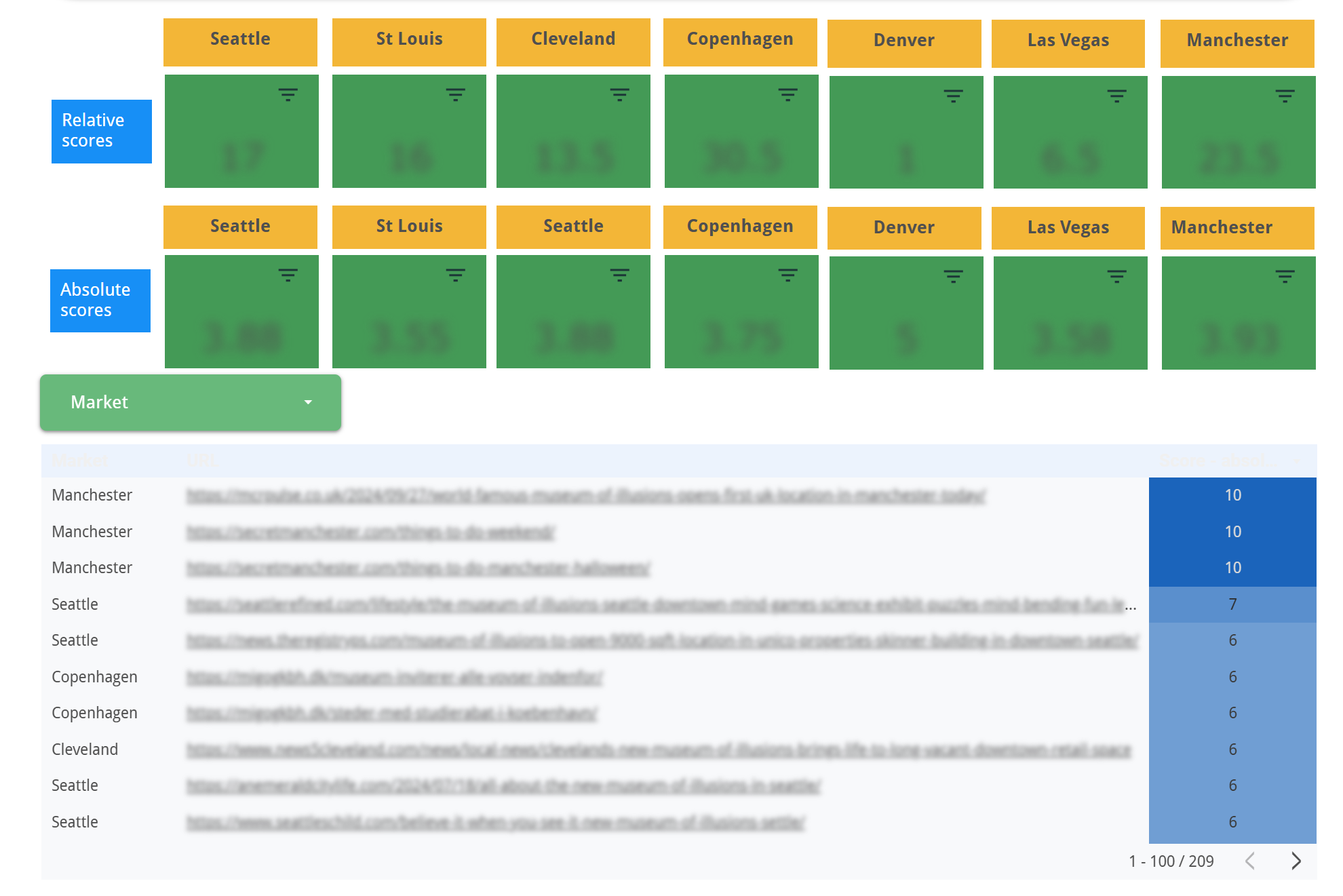
Multi-Criteria Evaluation Framework
Each article is analyzed across multiple dimensions to provide granular insights.
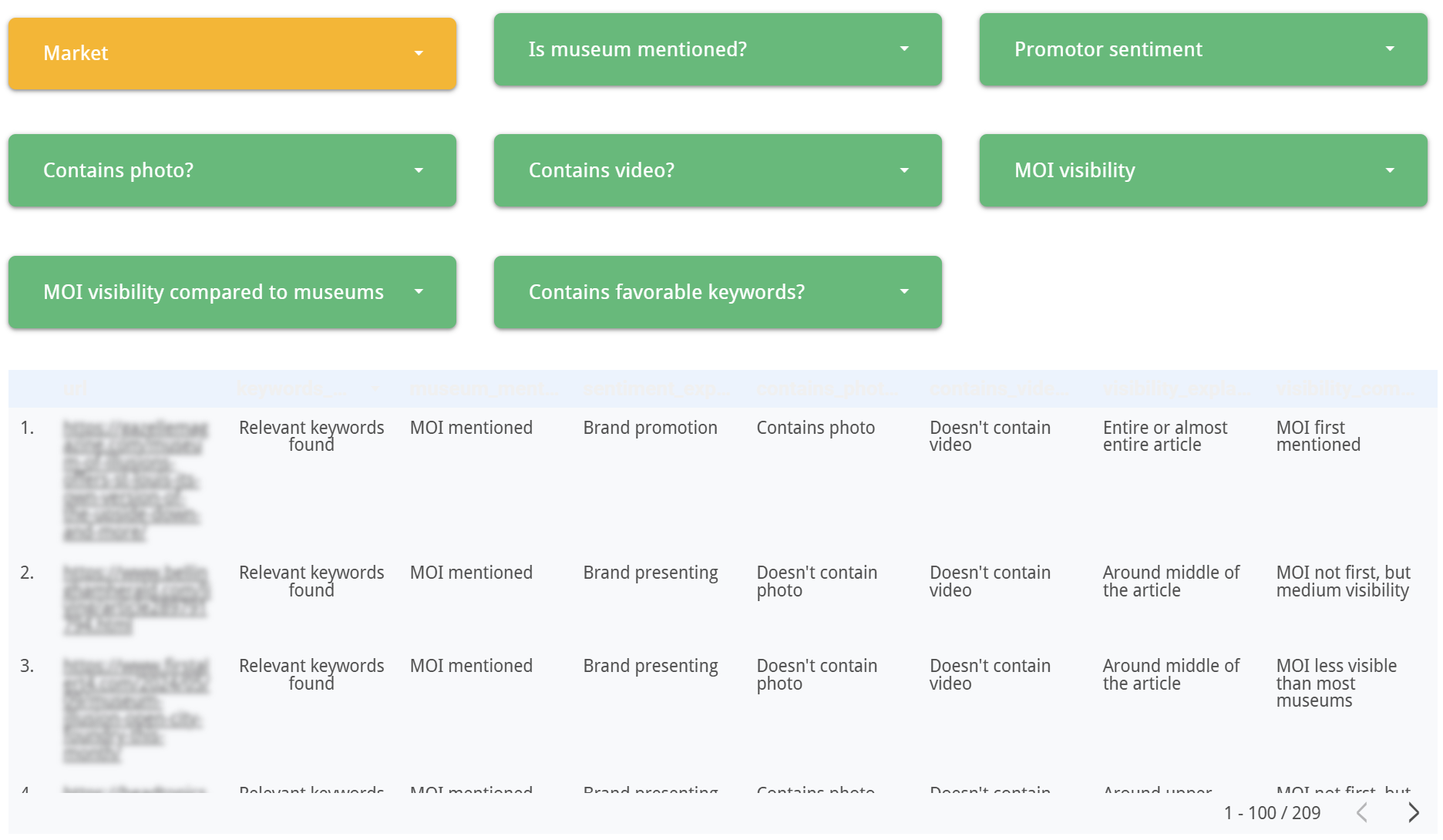
Brand Presence Metrics:
- Brand mention detection and frequency
- Physical visibility within the article (placement, prominence)
- Visibility compared to competitor mentions
- Presence of favorable context keywords (experience, fun, interactive, recommended, etc.)
Content Quality Signals:
- Sentiment analysis (negative to positive spectrum)
- Visual asset inclusion (photos, videos)
- Overall article depth and quality
Longevity Assessment:
- Article type classification (one-time news vs. evergreen listicle)
- Organic traffic generation potential
- SERP visibility tracking over time
Market-by-Market Visibility Tracking
We established ongoing monitoring of key listicle placements to track organic visibility changes. This revealed critical insights about SERP volatility, particularly during significant algorithm updates and identified which placements maintained value versus those requiring replacement.

Results
- Unified Global Measurement All markets now report through a single, standardized framework, enabling direct performance comparison.
- PR-to-Performance Translation PR investments can now be evaluated using metrics comparable to digital advertising, supporting more informed budget allocation.
- Proactive Placement Strategy Visibility tracking enables proactive identification of degraded placements, prompting timely reinvestment in high-value opportunities.
- Market-Specific Insights Granular data reveals optimization opportunities unique to each market, from Tripadvisor visibility in Atlanta to visitmanchester.com dominance in Manchester.