

They built a bespoke controlling system that tracks performance at the product, category, and keyword level, surfacing opportunities and flagging issues the moment they arise.
Client
ePlaneta
Expertise
- Expertise
- Search Demand Forecasting
- Data Warehouse Architecture
- GSC-to-BigQuery Pipeline
- Seasonality Modeling
- Competitive SERP Analysis
- Opportunity Prioritization
Year
2024 - Present

ePlaneta is one of Serbia’s leading online retailers, offering over 170,000 products across 2,000+ categories. With around 1,500,000 monthly visitors, the platform serves a wide range of customer needs. Granular has been a long-term partner, shaping their digital strategy — and as SEO matured into a top acquisition channel, the next challenge became not just ranking well, but knowing precisely when and where to focus limited optimization resources across a massive catalog.
Client words
For the past three years, Granular Group has been ePlaneta’s go-to partner for scaling our digital presence. They transformed SEO into our most effective acquisition channel, driving substantial year-over-year organic growth and helping us support half a million monthly visitors across our vast 170,000-item catalog. Their strategic guidance fueled rapid expansion in key verticals—household appliances, IT hardware, footwear, and apparel—solidifying our leadership in each.
Their greatest impact has been in empowering us with clear, actionable insights. They built a bespoke controlling system that tracks performance at the product, category, and keyword level, surfacing opportunities and flagging issues the moment they arise. This real-time visibility has enabled our teams to optimize campaigns swiftly, fine-tune content, and maintain steady conversion gains across the board.
With their proactive, hands-on collaboration, Granular feels like an extension of our team. They navigate cross-departmental hurdles with ease, continuously unlocking new revenue streams and ensuring ePlaneta is poised for sustainable growth in Serbia’s competitive eCommerce market.
Branimir Kulašević, Chief Ecommerce Officer

Challenges
Scale makes manual prioritization impossible
With over 2,000 product categories, each containing its own keyword universe, manually deciding what to optimize and when is not feasible. An SEO team can only work on a limited number of categories at a time. Without a system to surface which categories deserve attention right now, effort gets spread too thin or concentrated in the wrong places.
Seasonality is invisible without historical data
Search demand for most eCommerce categories follows seasonal patterns. Air conditioners peak in spring, heaters in autumn, school supplies in late summer, but these patterns vary in timing, intensity, and duration. Without historical impression data stored at sufficient granularity, it’s impossible to predict when a category is about to enter its demand window. And by the time you notice the traffic rising in real-time reporting, the optimization window has already passed.
No unified demand signal
Google Search Console shows impressions, but it is volatile and limited to 16 months. Google Trends shows relative interest but lacks absolute numbers. Clickstream data adds behavioral context but operates on a different scale entirely. Each source tells a partial story. Without a system that normalizes and blends these signals, there is no single reliable metric for search demand trajectory.
Rankings don’t reflect opportunity
A category could rank well for its core keywords but still underperform because demand is shifting to adjacent queries, or because competitors have captured featured snippets and SERP features that erode click-through rates. Conversely, a poorly ranking category might represent an enormous untapped opportunity if demand is surging. Without connecting demand trends to current visibility gaps, prioritization remains guesswork.
SEO planning is reactive, not predictive
Traditional SEO workflows respond to what has already happened: traffic drops, ranking losses, competitor movements. For an eCommerce platform of this scale, reactive planning means consistently arriving late to demand peaks. The optimization work needed to capture seasonal traffic (content updates, internal linking, technical improvements) takes weeks to execute and longer to take effect in rankings. Planning needs to happen well before demand materializes.
No way to weigh opportunity by business value
Even if demand trends were visible, not all categories carry equal business value. A category with rising search demand but low margins may be a worse investment than a smaller category with high profitability. Without integrating business data into the prioritization model, SEO planning optimizes for traffic rather than revenue.

Solution
Historical data warehouse on BigQuery
We built a persistent data warehouse that ingests and stores ePlaneta’s Google Search Console data via native BigQuery bulk export, preserving historical impression, click, position, and query data beyond GSC’s standard 16-month retention. This creates a growing, queryable archive of organic search performance at the query, URL, and category level, the foundation on which everything else is built.
Multi-source demand signal blending
Raw GSC impressions are inherently volatile — a single day’s fluctuation can distort trend calculations. We address this by blending GSC data with Google Trends and clickstream data to produce a stabilized, composite demand signal. Google Trends provides relative interest normalization and captures broader market movements, while clickstream data adds behavioral validation. The result is a single demand metric that is more reliable than any individual source.
Predictive seasonality modeling
Using the historical data warehouse, we calculate demand trajectories for each category by comparing current-period signals against corresponding historical windows. Rather than a simple year-over-year comparison, the model calculates divergence from historical averages, accounts for trend direction and acceleration, and identifies the specific week when demand begins its seasonal ascent. This gives the SEO team a precise “start targeting by” date for each category — typically 4–8 weeks before peak demand, enough time for optimization work to take effect in rankings.
Emerging topic detection
Not all demand is seasonal. Some categories see sudden growth driven by new product launches, market shifts, or cultural trends that have no historical precedent. The system flags these “emerging topics” — queries or clusters showing significant recent growth without a corresponding signal in prior-year data, ensuring new opportunities aren’t invisible simply because they didn’t exist before.
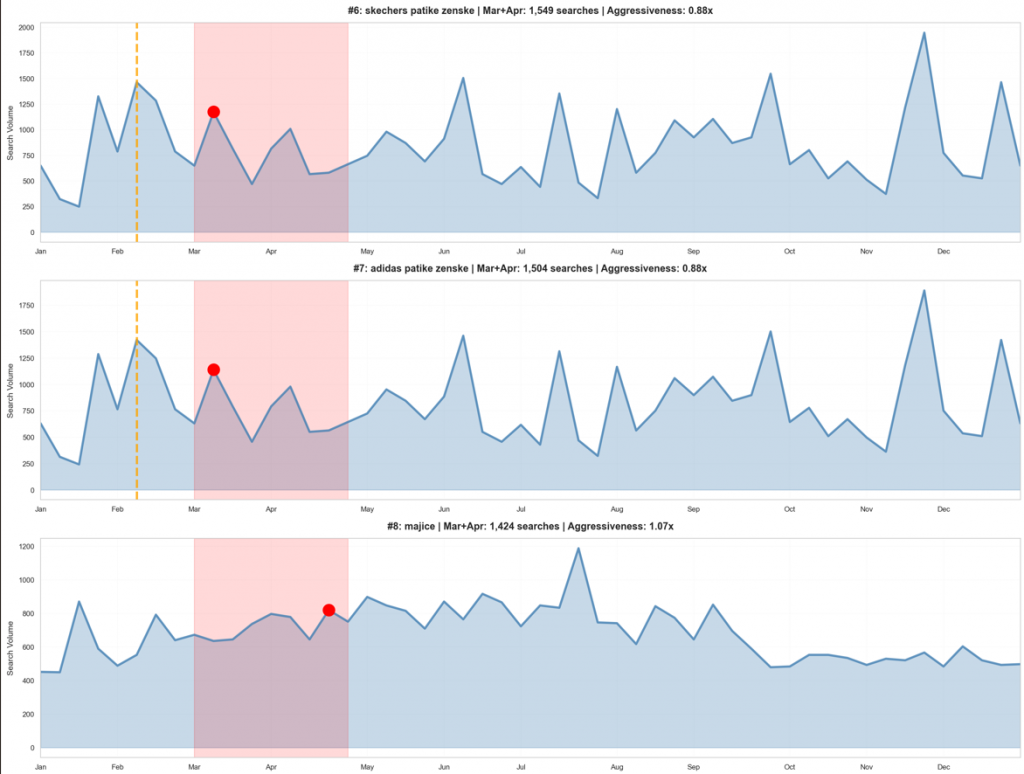
Top 50 keywords by volume
Profitability-weighted opportunity scoring
Search demand alone doesn’t determine where to invest. We integrate ePlaneta’s internal data on category-level revenue and margins to produce a composite Opportunity Score that weights demand trends by business value. This means a moderately growing high-margin category can outrank a fast-growing low-margin one in the prioritization model, aligning SEO planning directly with commercial outcomes.
Automated competitive SERP analysis
For each prioritized category, the system automatically analyzes the current top-10 Google SERP results to assess competitive difficulty. It evaluates ePlaneta’s current ranking positions against top competitors, identifies which domains and pages dominate each topic cluster, and generates optimization recommendations based on what the highest-performing pages are doing differently, from content structure to on-page signals.
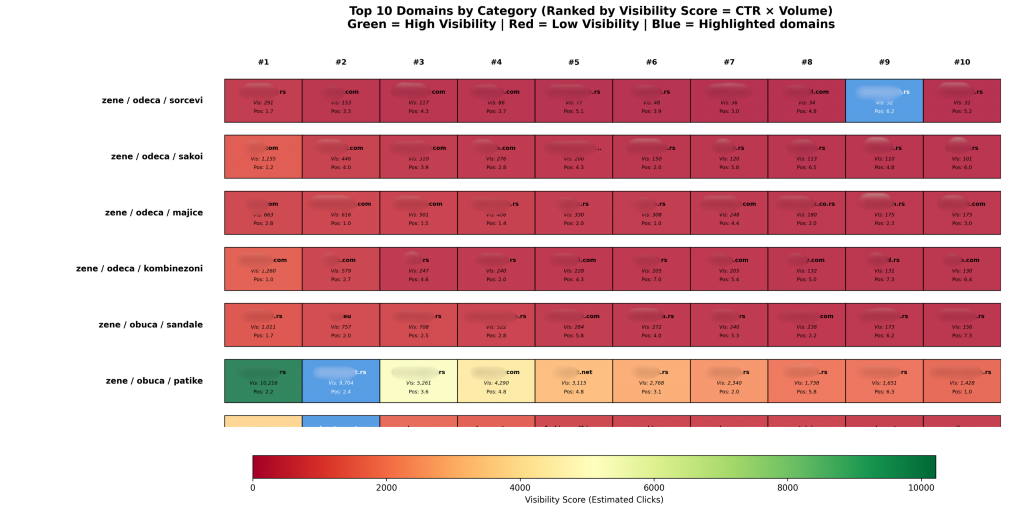
Top 10 domains by category
Unified priority dashboard
All of this feeds into a single planning interface where the SEO team can view categories ranked by historical demand, emerging demand, opportunity score (demand × profitability), and difficulty (distance from optimal visibility). For each category, they can drill into the top keywords, ePlaneta’s current rankings, competing pages, and a summary of recommended actions. This transforms SEO planning from a monthly brainstorm into a data-driven operating rhythm.
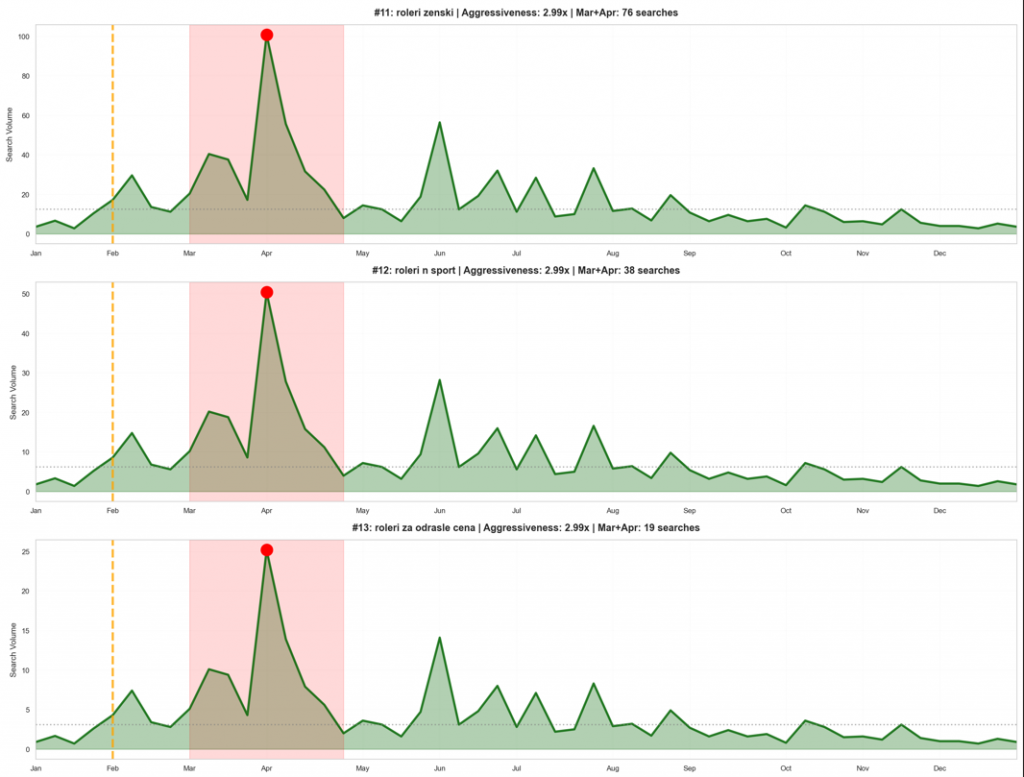
Top 50 keywords by aggressiveness

Results
- Predictive Planning Capability The SEO team now operates on a forward-looking calendar, with category-level optimization work scheduled weeks before demand peaks rather than in response to them.
- Demand Visibility Across 2,000+ Categories Every product category now has a quantified demand trajectory, eliminating the guesswork that previously drove prioritization decisions.
- Business-Aligned SEO Investment Profitability weighting ensures that SEO effort concentrates where it generates the highest commercial return, not just the most traffic.
- Persistent Data Asset The BigQuery warehouse preserves historical search data indefinitely, compounding in analytical value with each passing month and enabling increasingly accurate seasonal predictions.