

Their work in implementing tracking and reporting tools contributed to a clearer understanding of our marketing data and operational efficiencies, resulting in a more efficient and effective output overall.
Client
Museum of Illusions
Expertise
- SERP Landscape Analysis
- Topic Cluster Segmentation
- PR Opportunity Mapping
- Multi-Market Intelligence
- Competitive Visibility Tracking
- Strategic Placement Planning
Year
2024 - 2025

Museum of Illusions operates 60+ locations across 28 countries. As a location-based entertainment brand, their visibility challenge is unique: they’ll never outrank Tripadvisor, tourism boards, or established listicles for terms like “things to do in Atlanta” or “museums in Las Vegas”, nor would the investment to try be worthwhile.
Client words
Over the past year, Granular has worked with us to support the development of a more structured and data-informed digital marketing approach. They assisted with setting up digital marketing controls and reporting, PR monitoring, and paid advertising support, which helped us improve our ability to track campaign performance and better inform our decision-making.
Their work in implementing tracking and reporting tools contributed to a clearer understanding of our marketing data and operational efficiencies, resulting in a more efficient and effective output overall.
The collaboration has been professional and we consider Granular as an extension of our team as we continue to refine and grow our marketing processes.
Ryan Saddik, Global Director of Marketing

Challenges
Traditional SEO Doesn’t Apply
For most businesses, SEO means ranking your own pages. For Museum of Illusions, that model breaks down entirely. A single location will never outrank Tripadvisor, city tourism sites, or major publications for terms like “what to do in Paris” or “best museums in Manchester.” The search volume is there, but the competitive reality makes direct organic ranking impossible—and even if achievable, not worth the investment.
Visibility Lives in Earned and Paid Placements
MOI’s organic visibility comes almost entirely through third-party mentions: listicles, tourism guides, review aggregators, and local publications. This shifts the strategy from “how do we rank?” to “how do we get placed on the pages that do rank?”
SERPs Change Constantly
What ranks today may not rank tomorrow. Algorithm updates, new competitors, and SERP feature changes mean the landscape is never static. A listicle that drove significant visibility six months ago may now sit on page two.
Topic Diversity Complicates Planning
“Things to do” is just one angle. MOI could position as a date spot, a family activity, a rainy day option, a quirky hidden gem, or a must-see museum. Each positioning targets different search behaviors—and different SERP landscapes.
No Framework for PR Prioritization
Without systematic SERP analysis, PR decisions were often reactive or based on agency recommendations without visibility data. There was no way to answer: “For this market, for this positioning angle, which placements actually matter?”

Solution
Comprehensive Market Mapping
We built an intelligence system that analyzes SERP landscapes across all active markets, not at the keyword level, but at the topic cluster level. This provides a strategic view of where visibility lives for different positioning angles.
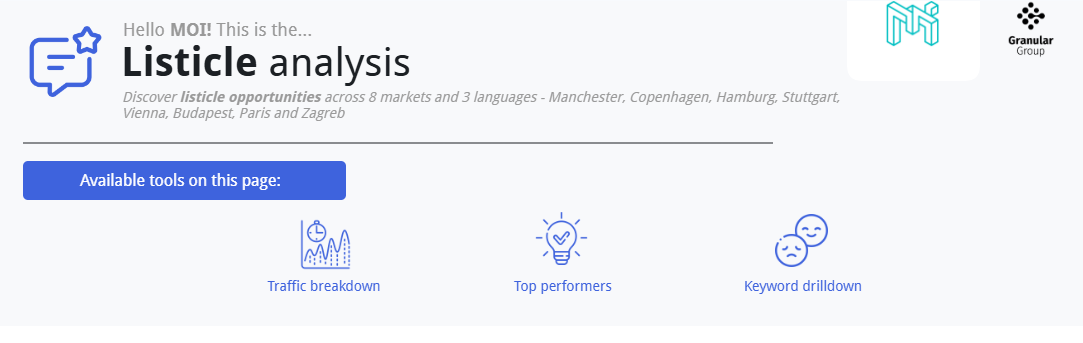
Listicle analysis dashboard
Hierarchical Topic Segmentation
Keywords are grouped into topic clusters and subcategories that align with real PR planning needs.
Broad Topic Categories:
- Tourist Attractions & Sights
- Museums
- Kids Activities
- Indoor & Rainy Day Activities
- Special Occasion Ideas
- Quirky & Hidden Gems
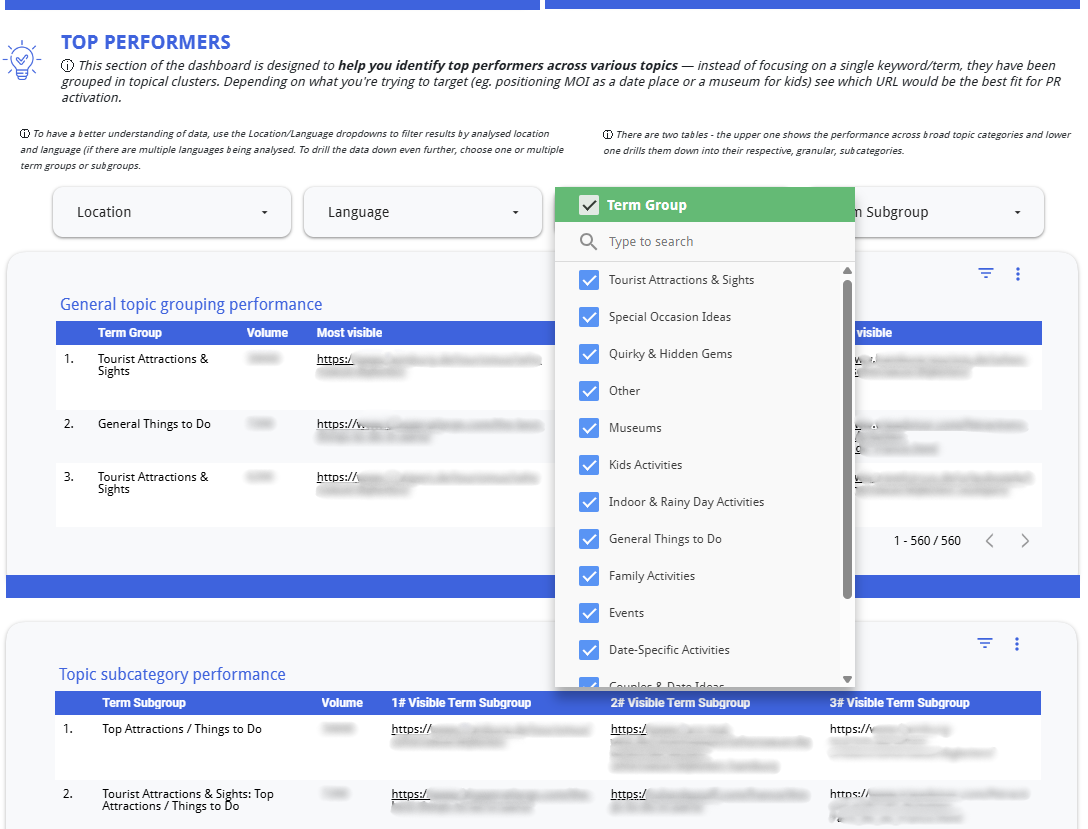
General topic categories
Granular Subcategories:
- Alternative / Fun / Quirky Date Ideas
- Children’s Museums / Family-Friendly
- Best / Top Museums
- Birthday Ideas
- Cheap Date Ideas
- Anniversary Date Ideas
- Cool / Crazy Things to Do
- 2-Day / 3-Day Itineraries
- Adults-Only Activities
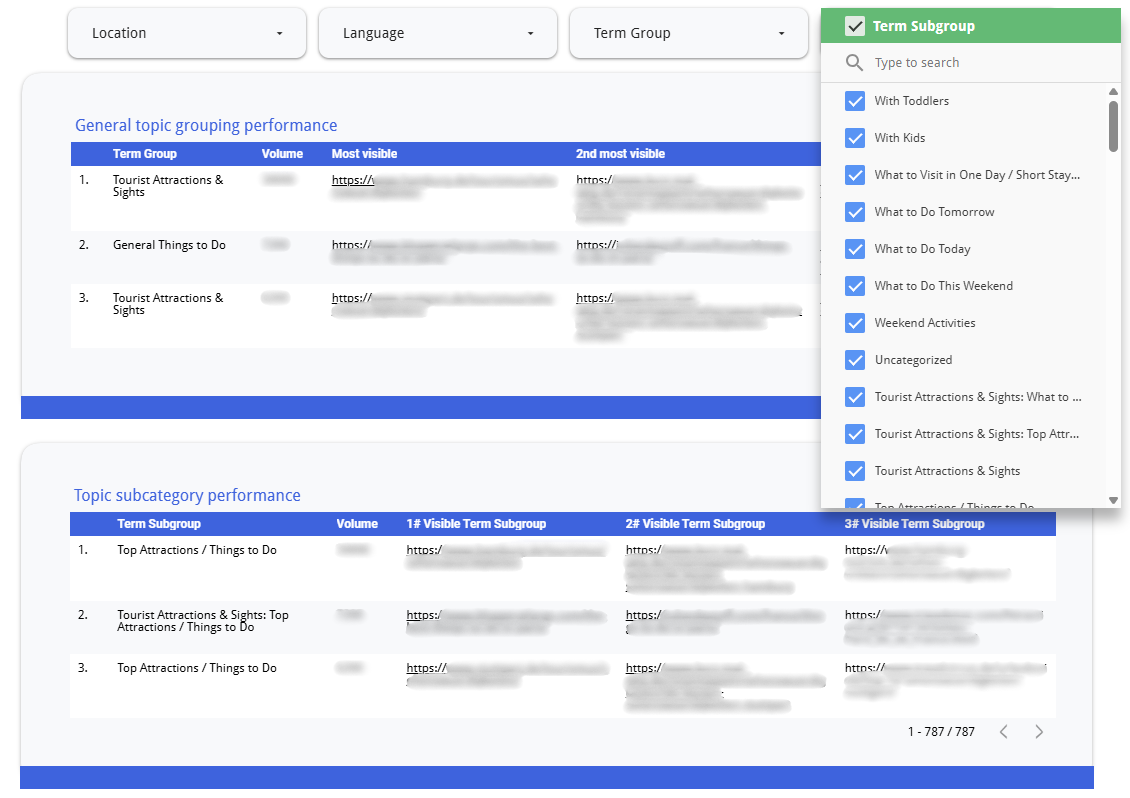
Topic subcategories
This segmentation means MOI can ask “Where should we invest to position as a date spot in Hamburg?” and get a data-driven answer.
Top Performer Identification
For each topic cluster in each market, the system identifies which URLs currently capture the most visibility. This reveals:
- Which domains dominate specific topics
- Which individual URLs are worth pitching for inclusion
- How often a domain appears across multiple relevant topics (indicating partnership potential)
- Estimated traffic for each placement opportunity
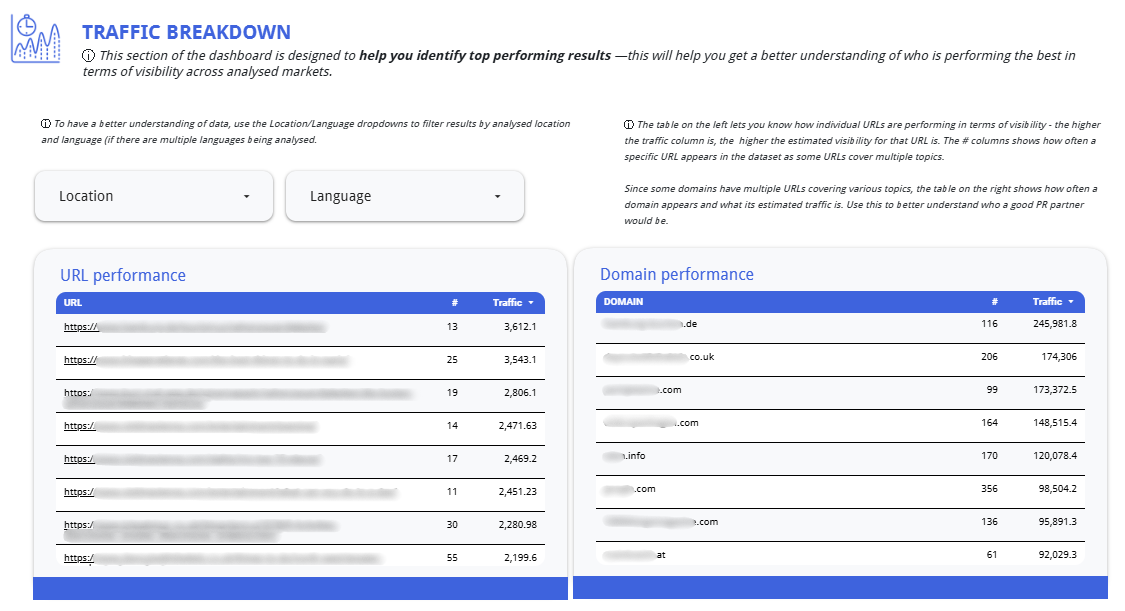
Traffic breakdown
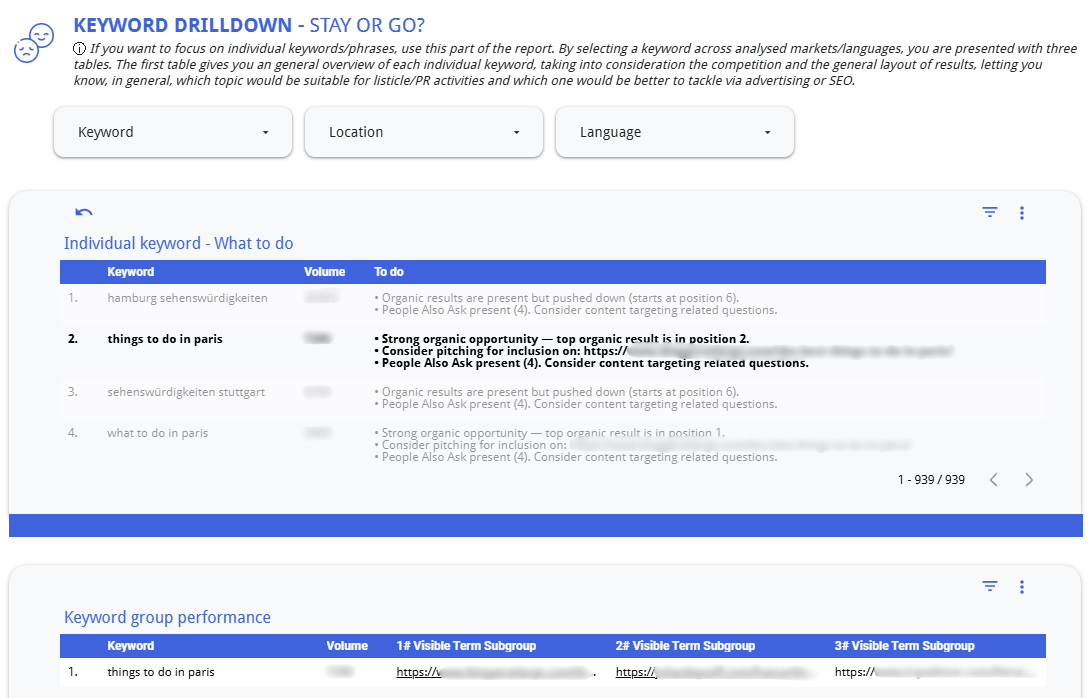
Keyword drilldown
Continuous Monitoring
Because SERPs shift constantly, this isn’t a one-time analysis. Regular updates track visibility changes, surface new opportunities, and flag when previously valuable placements have lost traction.

Results
- Data-Driven PR Planning PR investments are now guided by actual SERP visibility data rather than intuition or agency recommendations alone.
- Topic-Aligned Strategy Different positioning angles (family, date, museum, quirky) can be pursued with market-specific placement targets.
- Partner Prioritization Domain-level analysis reveals which publications or platforms offer the highest strategic value across multiple relevant topics.
- Proactive Opportunity Identification New high-value placement opportunities are surfaced systematically rather than discovered accidentally.