

With their pragmatic, hands-on collaboration, Granular feels like an extension of our own team — continuously driving improvements, expanding our reach across core categories, and keeping Planeta Sport a step ahead of the competition.
Client
Planeta Sport
Expertise
- Search Demand Forecasting
- Data Warehouse Architecture
- GSC-to-BigQuery Pipeline
- Sports Seasonality Modeling
- Competitive SERP Analysis
- Opportunity Prioritization
Year
2024 - Present

Planeta Sport is Serbia’s largest sports retail chain, with over 110 specialized stores across 60+ cities and a strong online presence through planetasport.rs. The brand carries sportswear, footwear, and equipment from globally recognized brands, serving everyone from competitive athletes to lifestyle buyers.
Granular has been a long-term strategic partner, and as organic search matured into one of their fastest-growing channels, the next question shifted from “how do we rank better?” to “how do we know which category to work on this week, and why?”
Client words
For the past three years, Granular Group has been our strategic partner in scaling Planeta Sport’s digital presence. They transformed SEO into our fastest-growing channel, delivering year-over-year organic growth. Their deep market insights and tailored content — from expert buying guides to seasonal trend features — helped us engage both seasoned athletes and casual fans, while they provide our teams instant clarity to act on every opportunity. With their pragmatic, hands-on collaboration, Granular feels like an extension of our own team — continuously driving improvements, expanding our reach across core categories, and keeping Planeta Sport a step ahead of the competition.
Branimir Kulašević, Chief Ecommerce Officer

Challenges
The sports calendar creates dozens of overlapping demand windows
Sports retail doesn’t follow a single seasonal curve. It follows many, all running in parallel. Running shoes build through spring, football boots spike around tournament season, ski equipment peaks before winter, sneaker demand surges at back-to-school, and fitness gear climbs every January. Each category has its own timing, its own ramp-up period, and its own competitive dynamics. An SEO team can only actively optimize a handful of categories at a time, so the question isn’t whether to prioritize; it’s how to know which categories are about to matter most in the next four to eight weeks.
Peak demand is only visible after it’s too late
The optimization work needed to capture a seasonal traffic peak (updating category pages, adjusting internal linking, refreshing content, improving technical signals) takes weeks to execute and even longer to register in rankings. By the time a category visibly starts climbing in weekly traffic reports, the window for influencing that peak has already closed. Without forward-looking data, every seasonal cycle is a missed opportunity discovered in hindsight.
Each data source tells a different story
Google Search Console captures real impressions but is noisy and capped at 16 months of history. Google Trends reflects broader interest movements but has no absolute scale. Clickstream data shows behavioral patterns but doesn’t map cleanly to search intent. When a category manager asks “Is demand for trail running shoes rising?”, the answer depends on which source you check, and none of them alone is reliable enough to bet operational resources on.
High rankings can mask declining opportunity
A category can hold strong positions for its core keywords while the market quietly shifts underneath it. Competitors capture new SERP features, adjacent queries gain volume, or consumer interest migrates to sub-niches that the existing page structure doesn’t cover. In sports retail, where brand-name searches (Nike, Adidas, New Balance) dominate volume, separating genuine organic opportunity from branded noise is especially difficult. Current rankings are a snapshot, and they don’t tell you whether the opportunity is growing or shrinking.
Not all traffic is worth the same to the business
A trending category with thin margins may generate impressive traffic numbers but limited commercial value. A smaller category with strong margins and rising demand could be a far better investment of SEO resources. Without integrating business data into the prioritization model, the team optimizes for visibility rather than profitability, which is a misalignment that compounds across hundreds of categories.

Solution
Persistent search data warehouse
We built a BigQuery-based data warehouse that captures and stores Planeta Sport’s Google Search Console data through native bulk export, preserving impression, click, position, and query data indefinitely, well beyond GSC’s standard 16-month retention.
For a sports retailer, where meaningful year-over-year comparisons require at least two full annual cycles (to account for tournament years, weather anomalies, and shifting school calendars), this persistent archive is the asset that makes everything else possible.
Composite demand signal
Rather than relying on any single data source, we blend GSC impressions with Google Trends and clickstream data to produce a stabilized demand metric per category. Google Trends captures macro movements (e.g., a World Cup year drives different football demand than an off year). Clickstream data validates whether search interest is translating into actual browsing behavior. The blended signal is more stable than raw impressions and more actionable than any source in isolation.
Week-level demand forecasting
The system calculates demand trajectories for each category by measuring how current signals diverge from historical baselines, accounting for trend direction, acceleration, and the specific week when seasonal demand begins to climb. The output is practical: a “start optimizing by” date for each category, set 4–8 weeks ahead of the projected peak. For the SEO team, this replaces intuition with a calendar they can plan against.
Profitability-weighted prioritization
We integrate Planeta Sport’s internal margin and revenue data at the category level to produce a composite Opportunity Score. This means a moderately trending high-margin category (e.g., premium running shoes) can outrank a fast-growing low-margin one (e.g., basic socks) in the planning queue, aligning SEO execution directly with business outcomes rather than traffic volume.
Automated competitive positioning
For each prioritized category, the system pulls the current top-10 SERP results and evaluates Planeta Sport’s positioning against competitors, identifying which domains dominate, what content patterns the top pages share, and where the specific visibility gaps are. This generates per-category optimization briefs without requiring manual research.
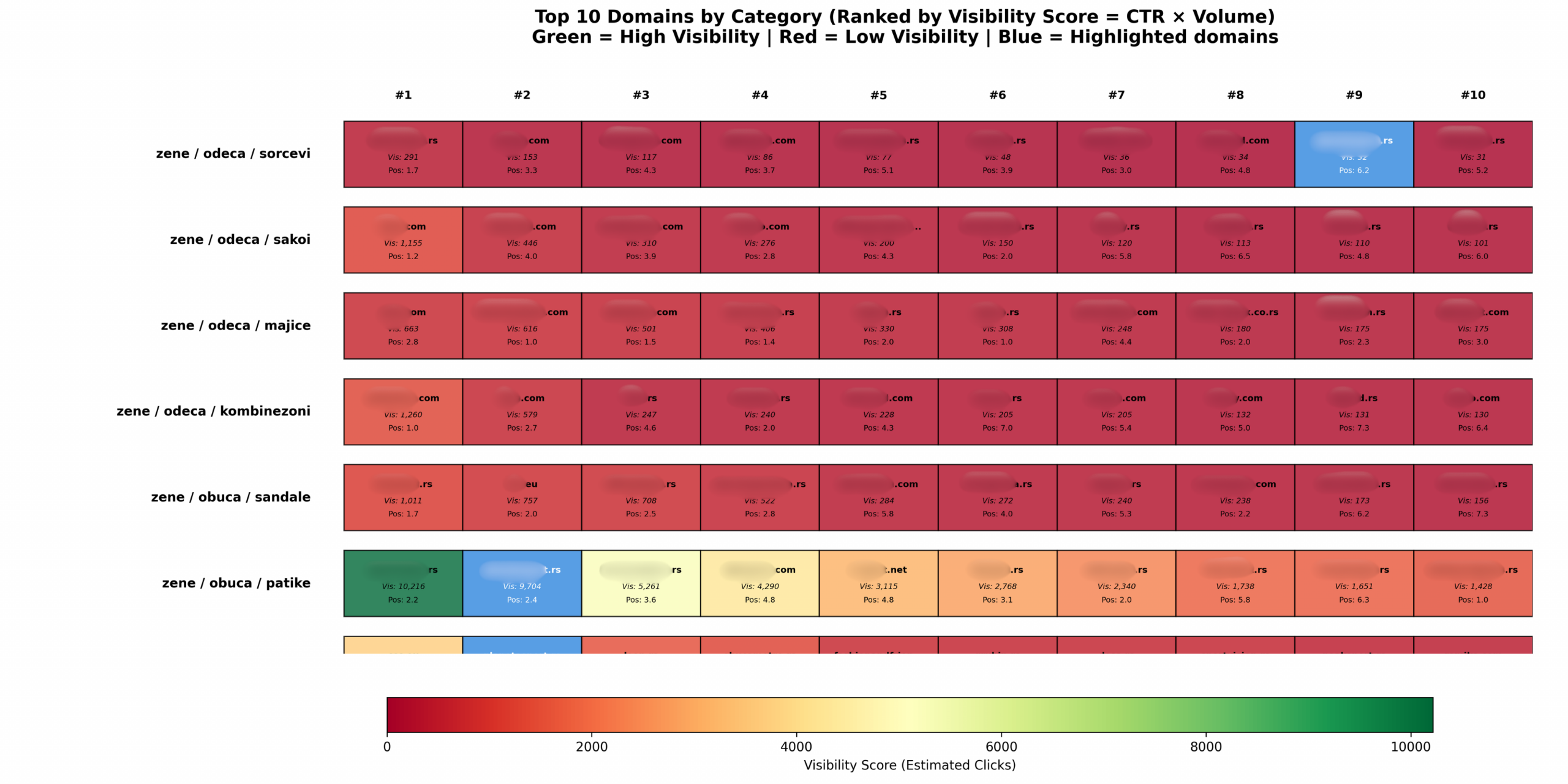
Top 10 domains by category
Single planning interface
Everything converges in one dashboard where the team can sort categories by historical demand trajectory, emerging demand, opportunity score (demand × margin), or competitive difficulty. Each category drills down to its top keywords, current rankings, competing pages, and recommended actions. SEO planning becomes an operating rhythm rather than a periodic brainstorm.
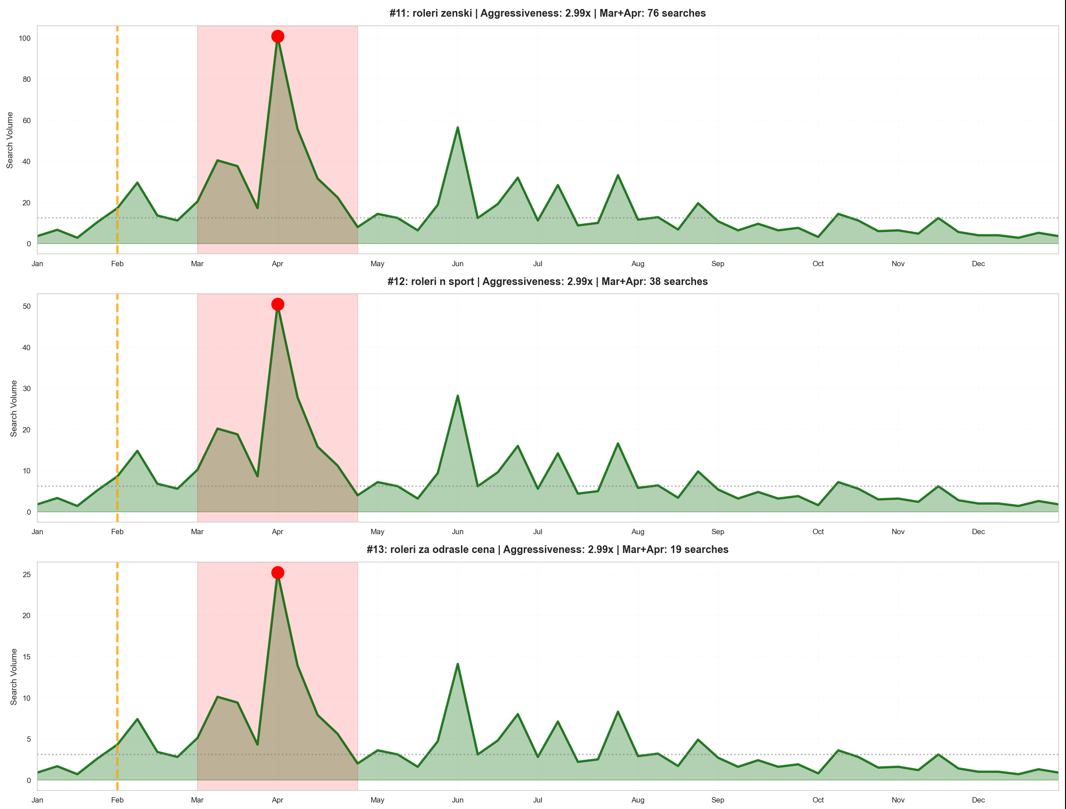
Top 50 keywords by aggressiveness

Results
- Predictive Planning Capability The SEO team now works from a forward-looking calendar, scheduling category optimization weeks before demand peaks rather than scrambling to respond after traffic starts rising.
- Full-Catalog Demand Visibility Every sports category has a quantified demand trajectory with a specific timing window, replacing the guesswork and gut feel that previously drove prioritization.
- Commercial Alignment Profitability weighting ensures SEO effort flows to the categories that generate the most revenue, not just the most clicks, a critical distinction in multi-brand sports retail where margins vary dramatically by category.
- Compounding Data Advantage The warehouse grows more valuable with each passing season. Two years of data is good; three years, capturing both tournament and non-tournament cycles, makes the predictions significantly sharper.