



The blind spot of the high-value event
Most management teams focus on the volume of conversions, but the real power lies in the quality of the match. When a user makes their first deposit, Meta attempts to link that action to a specific profile in its database. This is the Event Match Quality (EMQ) score.
If you are only sending a basic signal that a “Deposit” happened, you are essentially giving Meta a puzzle with half the pieces missing. The algorithm knows a transaction occurred, but it cannot tell who performed it. Without that identity “handshake,” Meta cannot optimise your ads for similar high-value users. You end up with a machine that is running on half-power, unable to build accurate lookalikes or retarget users with the precision that a regional leader requires.
The problem: Data without identity
We recently solved this exact bottleneck for a client where the “First Time Deposit” and “Deposit” events were firing, but the match quality was dangerously low. The system was technically working, yet the algorithm was guessing. It was a silent performance killer. Because the data was anonymous, Meta’s attribution was honest but incomplete. The machine saw the success but couldn’t learn from it, which meant the cost per acquisition remained stagnant even after the tracking was “fixed.”
In a post-cookie landscape, relying on the browser to tell Meta who the user is will always lead to failure. Privacy filters and ad blockers strip away the identifiers that the algorithm needs to see. To win, you have to stop sending empty events and start sending rich signals.
Our solution: Deep data infusion
We re-engineered the way these critical events are delivered. We didn’t just fire the event; we packed it with the identity data Meta craves.
We moved the logic to the server, where we could securely hash and bundle user information, like emails and phone numbers, directly into the “First Time Deposit” and “Deposit” signals. By filling these events with high-quality, encrypted identifiers, we transformed an anonymous click into a 95% match.
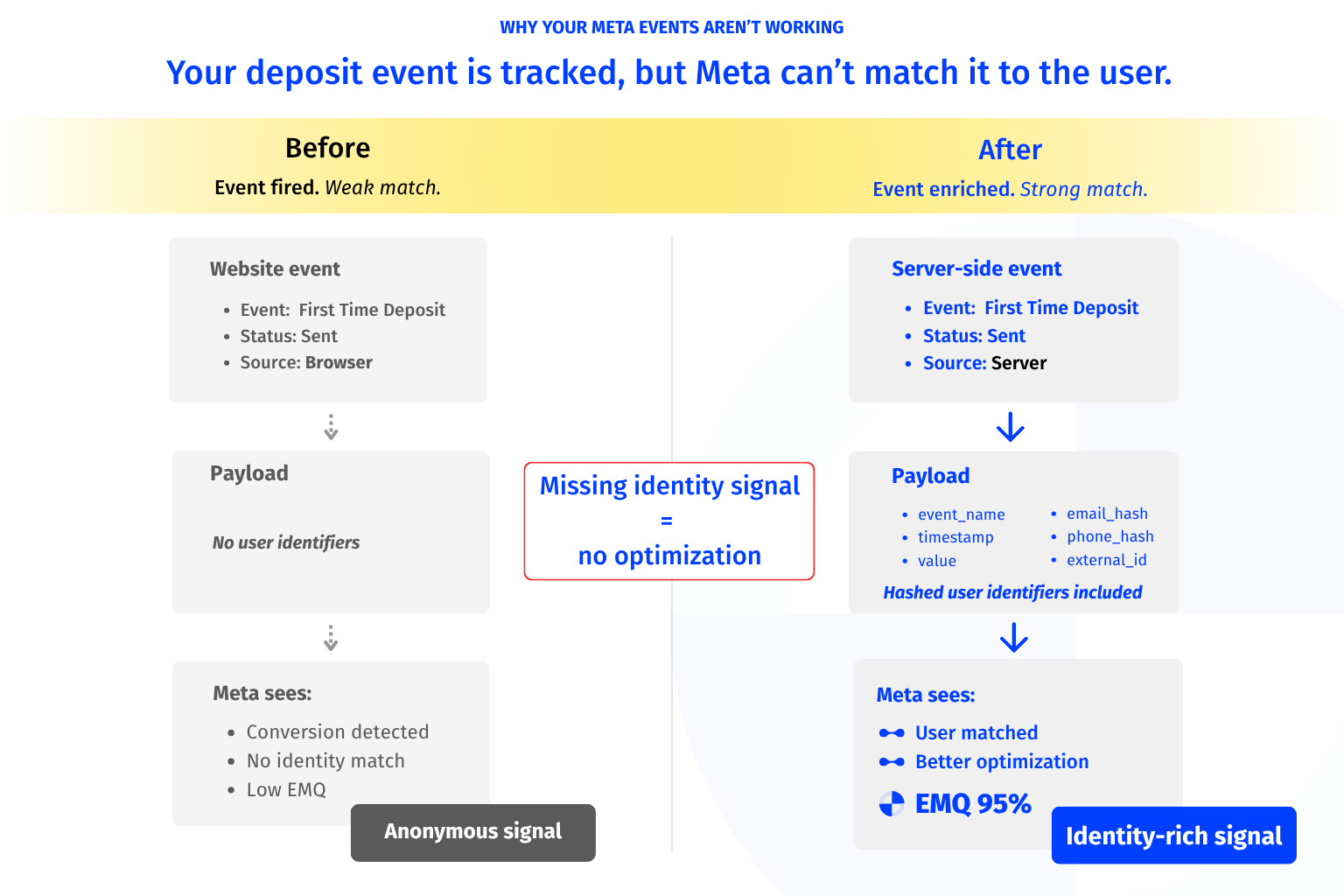
Same event, different signal quality
This deep infusion of data allows the “handshake” to happen every single time, regardless of what the user’s browser is trying to block. We made sure that every dollar deposited on the website was a lesson learned by the Meta algorithm.
Precision scaling and honest ROI
The results of fixing the EMQ on these specific custom events are immediate. When the algorithm finally knows exactly who is making the first deposit, it stops wasting your budget on broad reaches and starts finding the specific patterns that lead to profit.
The “black hole” in your attribution disappears. You finally see the true impact of your creative strategy because Meta can accurately claim the credit for the users it actually influenced. Most importantly, your ability to scale increases because your lookalike audiences are now built on solid ground, not anonymous ghosts.
Data integrity is the bridge between a campaign that survives and a brand that dominates the market. If your highest-value events aren’t talking to Meta in a language of identity, you are leaving your growth to chance.
