



We are talking about faceted navigation, the system of filters that lets users narrow down products by brand, price range, colour, size, and dozens of other attributes. When implemented correctly, faceted pages become high-performing landing pages that capture long-tail search queries and drive qualified organic traffic straight to your product listings.
When implemented poorly, they flood search engines with duplicate content, waste your crawl budget, and can even trigger ranking penalties.
Here is our complete guide on how we approach faceted navigation SEO for our clients, the exact technical setup we recommend, and the real results we have seen.
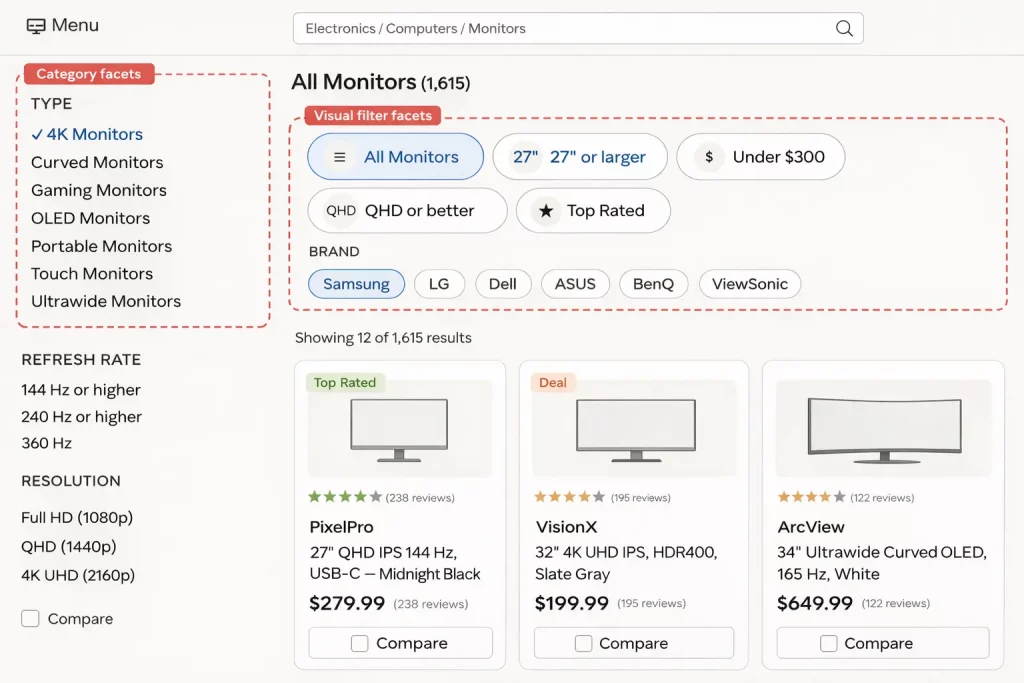
Visual representation of faceted navigation on e-commerce site
Why faceted navigation matters for SEO
Every digital marketer understands the value of ranking for high-volume head terms like “laptops” or “running shoes.” But here is what many overlook: the real revenue often comes from the long tail.
When a user searches for “Lenovo laptops 17 inch” or “Samsung phones under 500 EUR,” they are far deeper in the buying funnel than someone typing a generic category term. These searchers have a specific intent, and they are ready to compare and convert. Faceted navigation creates the exact landing pages that satisfy these queries.
The core principle is straightforward: if there is meaningful search volume behind a specific combination of filters (brand + category, category + price range, brand + screen size), then that combination deserves its own indexable, optimised page. A faceted page is not just a filter result. It is a purpose-built landing page that targets a real search query with a real audience behind it.
Without a proper faceted navigation strategy, you are leaving all of that long-tail traffic on the table for your competitors to pick up.
Where the untapped opportunity lives
Most e-commerce sites already have filters in their sidebar. Users click them every day. But from a search engine’s perspective, those filtered results are invisible. They are loaded dynamically via JavaScript, blocked by robots.txt, or canonicalised back to the parent category. In other words, Google never sees them.
The opportunity is in identifying which filter combinations carry significant search demand and then deliberately opening those pages for indexation. Here is where we typically find the biggest wins:
- Brand + Category combinations (e.g., “Samsung televisions,” “Nike running shoes”). These are almost always high-volume and high-intent.
- Category + Key Attribute combinations (e.g., “laptops 17 inch,” “wireless headphones with noise cancellation”). Users who are searching for specific product features are deep in their decision process.
- Category + Price Range combinations (e.g., “smartphones under 300 EUR”). Budget-driven queries are extremely common and convert well.
- Seasonal and trending filter combinations (e.g., “winter jackets women,” “back to school backpacks”). These have cyclical demand spikes that, if captured, can deliver massive traffic surges.
The key is research. We run comprehensive keyword analyses against our clients’ category and attribute structures to find every combination with worthwhile search volume. More often than not, the total addressable organic traffic from faceted pages exceeds the traffic potential of the base category pages themselves.
Our approach: what we do and what we advise our clients
After years of implementing faceted navigation strategies across e-commerce, price comparison, and marketplace platforms, we have developed a methodology that balances aggressive traffic capture with clean technical SEO. Here is how we approach it:
Start with search demand, not with filters
We never open faceted pages blindly. The first step is always an in-depth keyword research phase where we map search volumes against every possible filter combination in the client’s catalogue. Only combinations with validated search demand become faceted landing pages. Everything else stays blocked from indexation.
Control what gets indexed
This is where most sites fail. They either block all filter pages (missing the traffic opportunity) or allow all of them (flooding Google with thin, duplicate content). Our approach is selective: we define a precise list of facet combinations to open based on search data, and we keep everything else firmly closed. We call this the “controlled opening” strategy, and it is critical to avoiding crawl budget waste and duplicate content issues.
Optimise each faceted page individually
A faceted page is not just a category page with a filter applied. We treat every faceted landing page as its own unique asset. That means custom meta titles, meta descriptions, H1 tags, and category descriptions tailored to the specific search intent behind that filter combination. This is what separates a high-ranking faceted page from a thin doorway page that Google ignores.
Build internal link equity deliberately
Faceted pages need internal links to signal their importance to search engines. We advise placing links to key faceted pages in strategic positions: within category page descriptions, in dedicated link blocks above or below product listings, and in the site’s main navigation or footer for the most important ones. The goal is to make these pages discoverable by both users and crawlers.
The complete technical setup for faceted navigation
Getting the strategy right is only half the battle. The technical implementation is where faceted navigation either thrives or falls apart. Here is the full technical checklist we follow with every client:
1. Block non-facet filter pages from search engines
Efficient crawl budget management requires blocking filtered pages that have not been designated as facet landing pages. The most effective method is to ensure that non-facet filtered URLs are not internally linked anywhere on the site. If a filter does not correspond to a defined facet page, the sidebar filter should not output an <a href> tag. Additionally, all non-facet filtered pages should carry a canonical tag pointing back to the parent category page without any filter parameters.
2. Implement self-referencing canonical tags on faceted pages
Every designated facet page must include a canonical tag that points to itself, including the filter parameters that define the facet. Any additional parameters (UTM tags, session IDs, sorting parameters) must be stripped from the canonical URL. For example, if the facet page lives at website.com/laptops?brand=acer, the canonical should point exactly to that URL, even if the user arrived via a link with tracking parameters appended.
3. Add faceted URLs to a dedicated XML sitemap
All defined facet page URLs should be added to the XML sitemap to signal to search engines that these pages are intended for indexation. We recommend placing facet URLs in a separate sitemap file (e.g., /facets-sitemap.xml) for easier management and monitoring.
4. Add custom on-page elements to every faceted page
This is arguably the most important step for ranking performance. Each faceted page needs the ability to carry its own unique on-page elements through the CMS:
- Meta title – optimised for the target keyword of that specific facet combination.
- Meta description – written to maximise click-through rate from the SERP for the target query.
- H1 tag – unique, descriptive, and aligned with the search intent.
- Category description text – placed below the product listing, providing contextual content unique to that facet. This helps differentiate the page from the parent category and signals topical relevance to search engines.
Without these custom elements, faceted pages become thin content that Google has no reason to rank. The on-page optimisation is what transforms a filter result into a genuine, rankable landing page.
5. Set proper href attributes on sidebar filters
When a filter corresponds to a defined facet page, the filter element in the sidebar should contain a proper <a href> linking to the facet URL. When it does not correspond to a facet, the filter should function via JavaScript without outputting a crawlable link. This selective approach ensures that search engines discover and follow links only to the pages you want indexed, while keeping irrelevant filter combinations out of the crawl path.
6. Build structured internal links to faceted pages
Beyond the sidebar filters, faceted pages need additional internal link signals to establish their importance in the site hierarchy. Best practices we have seen work consistently include placing facet links in a dedicated block above or below the product listing grid on the parent category page. Some sites also embed them within the category description text or in a “popular searches” section. The goal is to make faceted pages an integral, visible part of the site architecture rather than hidden endpoints that only appear when a user clicks a filter.
7. Feature high-priority faceted pages in navigation or footer
For the highest-value faceted pages, particularly those tied to seasonal demand or trending product categories, we recommend elevating them into the site’s main navigation or footer. This sends a strong signal to search engines about the page’s importance and ensures maximum crawl frequency. However, this must be done strategically. Overloading the navigation or footer with too many facet links dilutes their value and clutters the user interface. We advise selecting only the top-performing or highest-potential faceted pages for this treatment.
The results: organic traffic growth from faceted pages
The theory is compelling, but what matters is what happens in practice. Across multiple client engagements, we have consistently seen faceted navigation strategies deliver significant organic traffic uplifts, often within the first few months of implementation.
When we open faceted pages backed by validated search demand, optimise them with unique on-page elements, and support them with a clean internal linking structure, the results speak for themselves. Faceted pages begin ranking for long-tail queries that the site was previously invisible for, bringing in new, highly qualified visitors who are closer to conversion than typical category page traffic.
Below are examples of consistent organic traffic growth across two of our client implementations, with faceted navigation contributing to the overall performance.
The charts are sourced from the Ultimate Google Search Console Dashboard by Bojan Basrak.
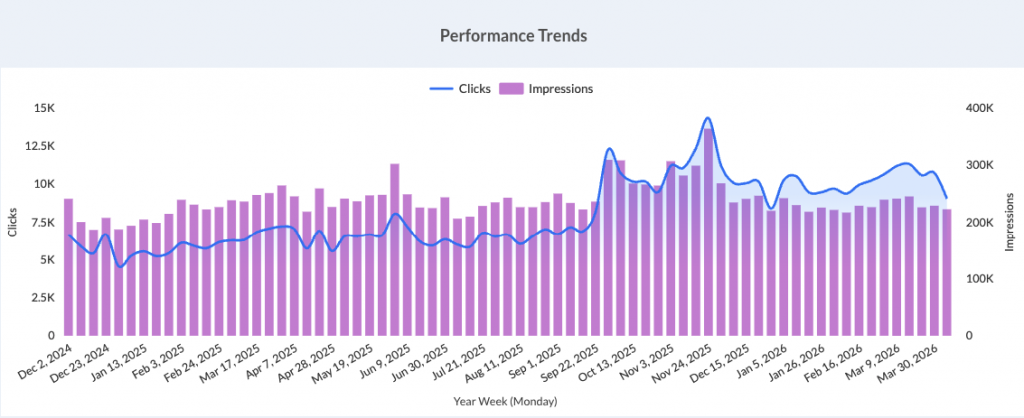
Client 1: Organic traffic growth on faceted pages
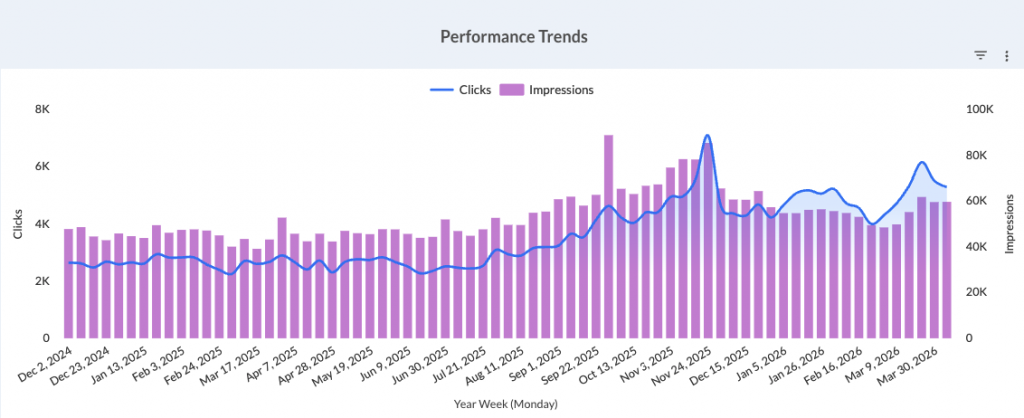
Client 2: Organic traffic growth on faceted pages
The pattern is consistent: once the technical foundation is in place and the right facet combinations are opened with properly optimised content, organic traffic to these pages grows steadily and compounds over time as Google gains confidence in their value.
Stop leaving long-tail traffic on the table
If your e-commerce site has hundreds or thousands of products with rich attribute data, you almost certainly have untapped organic traffic potential locked inside your filter system. The question is not whether faceted navigation can drive more traffic, but whether your current implementation is capturing that traffic or accidentally blocking it.
As your growth partner, we specialise in identifying these hidden opportunities, building the technical infrastructure to capture them, and optimising every faceted page to rank. We have done it across price comparison platforms, large e-commerce stores, and marketplace websites, and the methodology works every time.
Want to find out how much organic traffic your faceted pages could be driving? Fill out the form below to get in touch with our SEO team and explore how we can support your site’s faceted navigation potential.
